Applications of TCLR
By incorporating the TCLR into a thermodynamic kinetic framework, it becomes possible to accurately predict the rates of chemical reactions as a function of temperature, pressure, and other system variables. This can be useful in a variety of fields, including materials science, chemical engineering, and biochemistry, where accurate modeling of reaction rates is essential for the design and optimization of chemical processes.
Published Papers
1 : Formula discovery for the oxidation behavior of ferritic-martensitic steels in supercritical water
J Mater Inf, 2022;2:4, Cover Paper
A general formula with high generalization and accurate prediction power is highly desirable for science, technology and engineering. In addition to human beings, artificial intelligence algorithms show great promise for the discov- ery of formulas. Cao et al. (Paper Link) propose a domain knowledge-guided interpretive machine learning strategy and demonstrate it by studying the oxidation behavior of ferritic-martensitic steels in supercritical water. In this study, TCLR effectively captures the linear correlation between compositions, testing environments and oxidation behaviors from the data. The sure independence screening and sparsifying operator algorithm finally assembles the information derived from the tree classifier for linear regression algorithm, resulting in a general formula. The gen- eral formula with the determined parameters has the power to predict, quantitatively and accurately, the oxidation behavior of ferritic-martensitic steels with multiple alloying elements exposed to various supercritical water environ- ments.
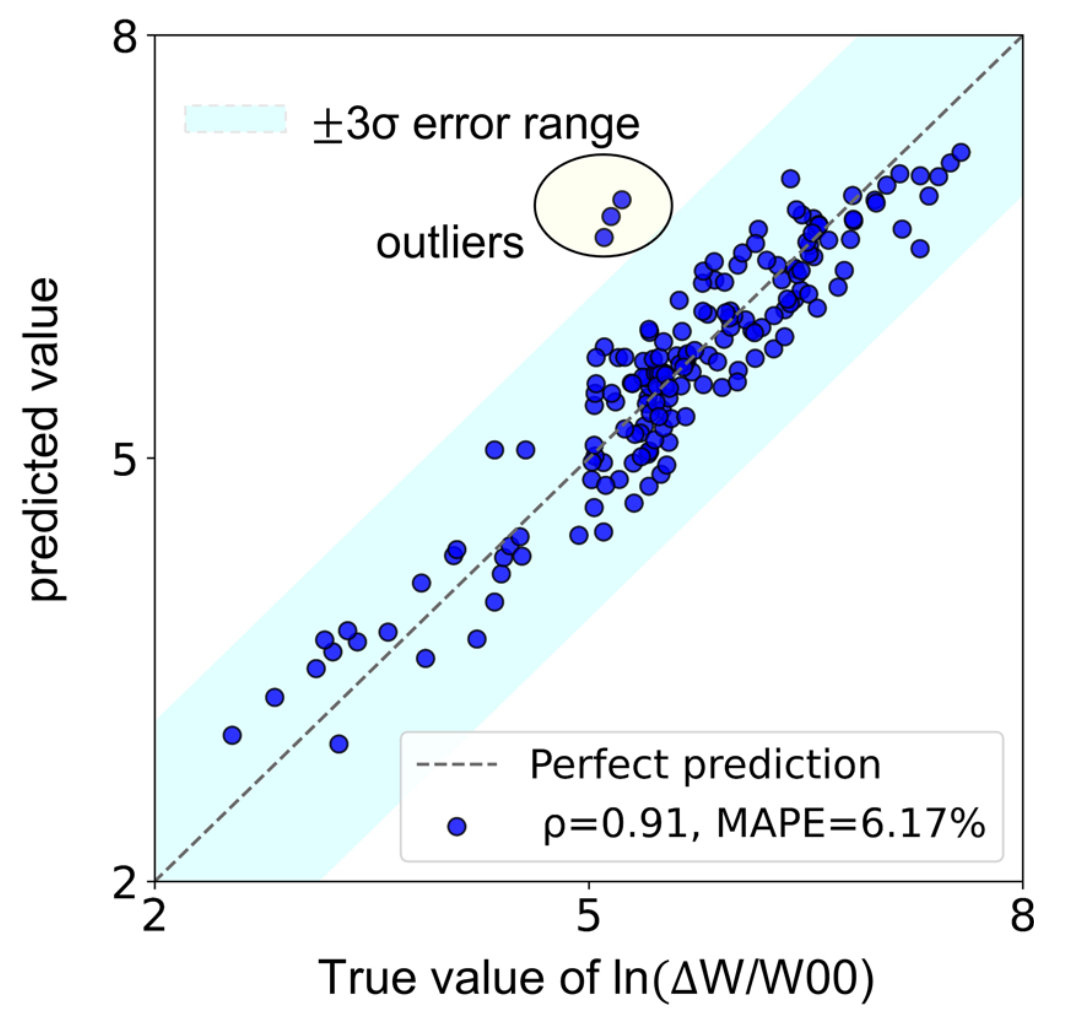
The generalized Arrhenius oxidation formula has very high prediction accuracy with a Pearson correlation coefficient 𝜌 of 0.91 and a MAPE of 6.17% validated by the 176 experimental data.
2 : Discovering a formula for the high temperature oxidation behavior of FeCrAlCoNi based high entropy alloys
Journal of Materials Science & Technology, Volume 149, 20 June 2023, Pages 237-246
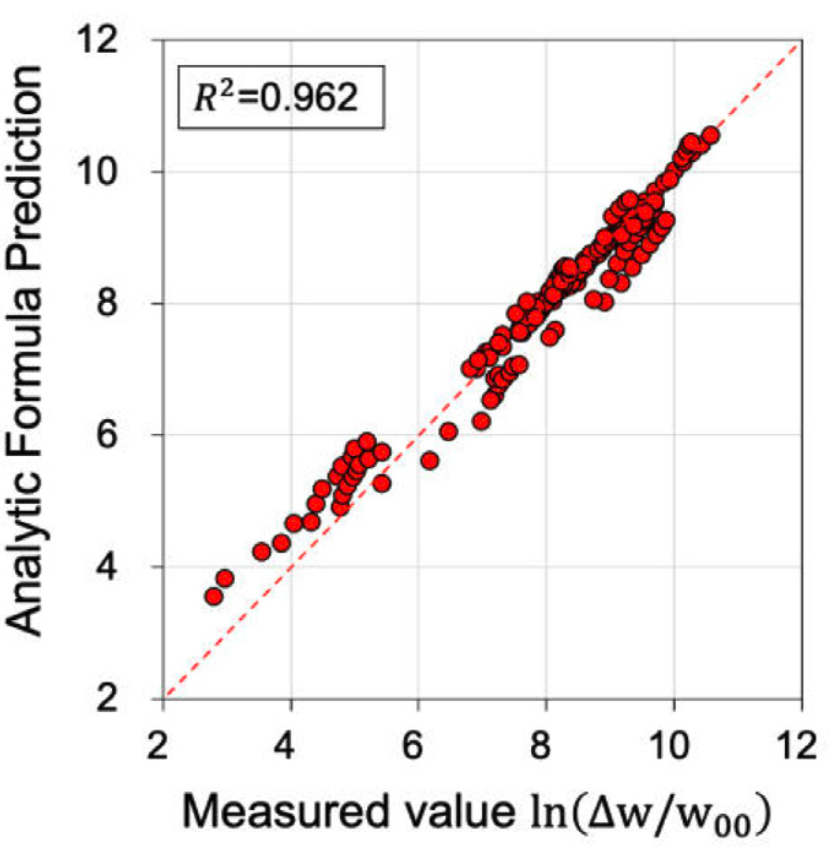
Wei et al. (Paper Link) performed a domain knowledge-guided machine learning to discover high interpretive formula describing the high- temperature oxidation behavior of FeCrAlCoNi-based high entropy alloys (HEAs). The domain knowledge suggests that the exposure time dependent and thermally activated oxidation behavior can be described by the synergy formula of power law multiplying Arrhenius equation. The pre-factor, time exponent (m), and activation energy (Q) are dependent on the chemical compositions of eight elements in the FeCrAlCoNi-based HEAs. The Tree-Classifier for Linear Regression (TCLR) algorithm utilizes the two exper- imental features of exposure time (t) and temperature (T) to extract the spectrums of activation energy (Q) and time exponent (m) from the complex and high dimensional feature space, which automatically gives the spectrum of pre-factor. The three spectrums are assembled by using the element features, which leads to a general and interpretive formula with high prediction accuracy of the determination coefficient R2=0.971. The role of each chemical element in the high-temperature oxidation behavior is analytically illustrated in the three spectrums, thereby the discovered interpretative formula provides a guidance to the inverse design of HEAs against high-temperature oxidation.
Related Papers
Google Scholar : Google Scholar